A hurricane-resistant sliding glass door is a door tested to withstand high wind pressure and flying debris, not a door that's indestructible. If you've searched for "hurricane-proof sliding glass doors," you've probably noticed that phrase everywhere, on manufacturer sites, in ads, in other companies' blog posts. It sounds reassuring. It's also not real, and not how Florida law even describes these products.
For homeowners in Brevard and Indian River Counties, that distinction matters more than marketing copy. Your home sits in a coastal wind zone with real building code requirements, and the difference between what a door is actually rated to do and what a headline promises can affect your safety, your insurance premium, and whether your next storm season is something you dread or something you've already handled. This article walks through what "hurricane resistant" actually means for a sliding glass door, which ratings apply to your specific area, what these doors can't guarantee, and how the insurance savings really work.
What Does "Hurricane Resistant" Actually Mean for a Sliding Glass Door?
"Hurricane resistant" means a door has been laboratory tested to withstand wind-driven debris impact and sustained wind pressure without failing. It does not mean the door is invincible. No sliding glass door, no matter how well built, is "hurricane proof," and that's a claim you should be skeptical of anywhere you see it.
The actual testing standard for this market is ASTM E1886/E1996, which defines both the impact test procedure and the performance requirements that a door must meet. In practice, that means a certified lab fires a large missile (typically a 9-pound piece of lumber) at the door at high speed, then subjects it to repeated pressure cycles that simulate sustained hurricane winds. A door that passes has earned its rating. That's a meaningfully different claim than "hurricane proof," and it's the honest one.
Sunset View uses "hurricane resistant" and "impact resistant" throughout our own product conversations for exactly this reason. It's not a lesser claim. It's the accurate one, and it's what the door is actually built and tested to do.
Design Pressure and Impact Rating Are Two Different Things
A sliding glass door's storm performance is actually measured by two separate ratings, not one. Impact rating tells you whether the glass and frame survive a direct hit from flying debris. Design pressure, or DP rating, indicates how much wind load the door can withstand before it fails structurally. A door can be excellent at one and mediocre at the other, so both numbers matter.
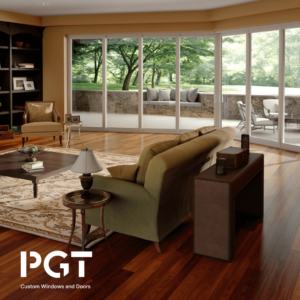
Most competitor content skips this distinction entirely, and it's worth understanding before you compare quotes. PGT's WinGuard line, which we use as the technical baseline for this market, carries a DP rating of +65/-70 PSF and is rated to withstand wind speeds up to 180 mph, the range associated with Category 5 storms. That combination of a strong DP rating and confirmed ASTM E1886/E1996 impact testing is what a genuinely storm-ready sliding door looks like on paper, not just in a sales pitch.
Do You Need Florida Product Approval or Miami-Dade NOA?
If you live in Brevard or Indian River County, your home needs Florida Product Approval (FPA), not a Miami-Dade Notice of Acceptance (NOA). This is one of the most common points of confusion in Florida window and door marketing, and it's worth clearing up before you make a decision.
Florida's wind-borne debris regions aren't all held to the same standard. Miami-Dade and Broward Counties fall under the High Velocity Hurricane Zone (HVHZ), which requires the stricter Miami-Dade NOA and TAS 201/202/203 testing. Brevard and Indian River Counties fall under the standard Wind-Borne Debris Region instead, where Florida's Division of Emergency Management confirms that ASTM E1886 and E1996 are the required testing standards, with Florida Product Approval as the correct certification.
That doesn't mean a Miami-Dade NOA is a red flag. PGT products typically carry both. It means a company that leads with Miami-Dade approval as the reason to trust a product for your address isn't wrong, exactly, just applying a stricter-market credential to a home that's governed by a different rule. Ask for Florida Product Approval on any door you're considering, since that's the certification your county's building department will actually check.
What These Doors Don't Guarantee
Hurricane-resistant sliding glass doors significantly reduce risk. They don't eliminate it entirely, and being honest about that is part of doing this right. A slider also isn't automatically the right layout for every opening. Weighing sliding doors against French doors, or considering other hurricane-rated door options, is worth doing before you settle on a product, since the right layout for your space matters as much as the wind rating. A few other things worth knowing going in:
- These doors are water-resistant, not waterproof. Testing accounts for wind-driven rain up to a certain threshold, not the kind of sustained flooding a major storm surge can bring.
- Performance depends on correct installation. A properly rated door installed poorly won't perform to its tested spec, which is part of why in-house installation matters as much as the product itself.
- The insurance premium credit tied to these doors isn't automatic. It requires a separate inspection step, covered in the next section.
- No door replaces basic storm prep. Hurricane-resistant doors are a serious upgrade to your home's protection, not a reason to skip evacuation orders or storm shutters where required.
How the Wind Mitigation Insurance Credit Really Works
Installing hurricane-resistant sliding doors can lower your insurance premium, but the discount doesn't apply on the day of installation. You'll need a licensed inspector to complete Florida's Uniform Mitigation Verification Inspection Form, confirmed by the Florida Office of Insurance Regulation as the required documentation under state law, before your insurer can apply any windstorm mitigation discount.
Here's the realistic version of how it plays out. You hire a licensed inspector to walk your property and document your home's wind mitigation features, including your new impact-rated openings. That inspection typically runs $150 to $300. The completed form goes to your insurance company, which then applies whatever discount their own rate filing allows, typically in the 10 to 30 percent range, to the windstorm portion of your premium, translating to roughly $300 to $500 a year for an average Florida home. The form stays valid for five years as long as nothing structural changes.
The credit is real. It just isn't automatic, and any homeowner told otherwise is being given incomplete information.
The Energy and Noise Benefits You'll Notice Every Day
Hurricane-resistant sliding doors don't just perform during storm season. Most homeowners notice the difference in their monthly energy bill and how quiet the house feels long before the next hurricane watch. The same laminated glass and tight frame seal that stops flying debris also blocks heat transfer and outside noise.
Replacing older sliding doors with impact-rated glass can reduce cooling costs by up to 30% in Florida's cooling-dominant climate, and can cut ambient noise by up to 65% compared to standard single-pane glass. For a home near a busy road, a golf course with landscaping crews, or just Florida's daily thunderstorm pattern, that's a difference you'll feel every afternoon, not just in June through November.
Frequently Asked Questions
What is a hurricane-resistant sliding glass door?
A hurricane-resistant sliding glass door is a door tested and certified to withstand high-velocity wind pressure and impacts from flying debris, typically in accordance with ASTM E1886/E1996 standards. It's built with laminated glass and reinforced framing designed to stay intact during a storm, though no door is truly "hurricane proof."
Is a hurricane-resistant sliding glass door the same as an impact window?
They use the same core technology, laminated glass bonded to resist shattering and a frame engineered to hold under pressure, but they're different products built for different openings. A sliding door also has to serve as a functional, frequently used entry point, which introduces engineering considerations a fixed window doesn't need to address.
Do I need Miami-Dade approval for hurricane-resistant sliding doors in Brevard County?
No. Brevard and Indian River Counties fall under Florida's standard Wind-Borne Debris Region, not the High Velocity Hurricane Zone, so Florida Product Approval is the certification that applies to your home. Miami-Dade NOA isn't required here, though many quality products carry both.
Is the insurance discount automatic once I install hurricane-resistant doors?
No. You'll need a licensed inspector to complete Florida's Uniform Mitigation Verification Inspection Form and submit it to your insurer before any windstorm premium discount is applied. The inspection is a separate step from installation.
How much do hurricane-resistant sliding glass doors cost?
Cost varies based on size, configuration, and frame material, much like hurricane impact window pricing depends on the same variables, so the honest answer comes down to your specific home. Sunset View offers a free, no-pressure quote so you can see exact pricing for your property rather than a generic estimate that may not reflect what your home actually needs.
Why Brevard and Indian River County Homeowners Choose Sunset View
Sunset View Windows & Doors has served Brevard and Indian River County homeowners for two decades, and every installer who steps onto your property is our own employee, not a subcontractor brought in for the job. That's what makes our 10-year workmanship warranty possible, a term most competitors can't match because they don't control the install from start to finish.
We're an authorized PGT Gold and Platinum Certified Dealer, which means our team completes manufacturer-level training most installers never touch. As a veteran-owned, family-operated company built here in 2006, we're not a national chain passing through your neighborhood for storm season. We live in these communities, and we're the ones you'll call if something needs a second look five years from now. Financing is available, and every quote starts with a no-pressure conversation about what your home actually needs.